
Collaboration History
| Year | Event |
|---|---|
| 1994 | Protocol Agreement was signed |
| 1995 | QAU joined CMS Collaboration |
| 1997 | Contract for 8 magnet-supports was signed |
| 1998 | Memorandum of Understanding signed |
| 1998 | CERN-CTC Computer Centre |
| 1999 | National Centre for Physics was established |
| 2000 | The enhancement in contribution from 1 MCHF to 2.445 MCHF (RPC Project) |
| 2000 | NCP became a full member institute of CMS |
| 2000 | LoI signed for the Regional Computer Center |
| 2001 | LoI signed for further contribution towards LHC |
| 2001 | Agreement between NCP and CERN |
| 2003 | Protocol signed for an additional contribution of US $ 10 million to LHC Project |
| 2004 | Addendum to 2003 Protocol signed between ATLAS and SES |
| 2006 | LoI for further contribution to LHC and future CERN projects |
| 2006 | MoU for Shielding door of LHC |
| 2006 | MoU for Grid Computing |
A committee Joint CERN-Pakistan Committee (JCPC) was constituted under article 10.1 of July 2003 Protocol, to monitor the execution of CERN – Pakistan Cooperation. This committee consists on 6 members from PAEC, NCP and CERN. According to the Protocol, the committee shall meet once a year or when considered appropriate by the parties. So far two meetings have been held.
Present Areas of Involvement
- Manufacturing of mechanical components & Engineering Services
- Detector Assembly and Testing
- HRD for Physics Analysis
- Grid Computing
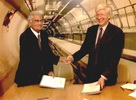
Chairman PAEC with DG CERN at CERN (1997)
Resistive Plate Chambers (RPC) Project
In the experimental HEP, we are involved in the development, testing and fabrication of 432 Resistive Plate Chambers (RPC) required for the CMS muon detector at CERN. The RPC has an excellent time resolution i.e. of the order of 1-2 nanoseconds and it will be used for the bunch tagging at LHC. At the national level, this project is a joint collaboration of NCP and PAEC, whereas at international level, we have partners from Italy, China, Korea and USA. The RPC is a gaseous detector made using two parallel-plates of bakelite with high resistivity. Each RPC for CMS will be equipped with 96 electronic channels, which will be readout are based on 0.14 micron BiCMOS technology. For the complete system, number of readout channels are around 50,000. Below is the information about the RPC project.
- First small-scale prototype was build in 1999
- Full-scale prototypes were built in 2001 - 03
- Tested successfully in X5 beam line 200 GeV muons
- Gamma Irradiation Facility (GIF)
- Engineering Design Review (EDR) was presented and approved in 10/02
- Group from Pakistan has contributed into:
- Mechanical Design
- Integration
- Assembly and Testing of 288 chambers
- Mechanical Design + Integration
- Front-End Electronics (50,000 channels)
- ASIC provided by CMS Collaboration
- Slow Control, Monitoring, Gas and Cooling System
- On-site installation of 10 deg. Chamber
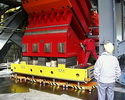
Magnet Support for CMS Detector - Dr. Hafeez R. Hoorani (1997)
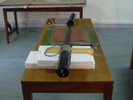
1st RPC Prototype in year 1999 |
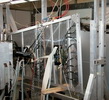
RPC Prototype in 2002 |
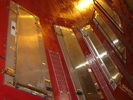
RPC Installation in the CMS Detector |
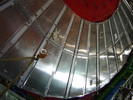
RPC Installation in the CMS Detector |
NCP has an experimental high energy physics laboratory which is equipped with the high speed and advanced data acquisition system based on VME standards. This laboratory is used for prototyping and testing of RPCs at present. RPCs are assembled and tested in this laboratory.
HRD for Physics Analysis
Following are the topics of interest:
- Analysis of RPC testbeam data
- Study of Standard Model Physics and Parameters
- Top quark pair production at LHC
- Detailed studies of RPC trigger
- e/ g /p0 separation
- H --> gg
Group of physicists
- 2 faculty members
- Theory + Experiment
- 3 SO (Physics)
- Quality Assurance + Data Analysis of Hodoscope
- 3 M. Phil students
- 3 M. Ph.D students
- Mechanical Design + Integration
- 6 M.Phil already completed
- Study of Test Beam Data Using X5 Beam at SPS of CERN (M. Irfan Asghar, 2002)
- The Study of RPC Trigger at LHC (M. Shahzad Anwar, 2002)
- The Study of Gas Gaps for CMS RPCs (Ijaz Ahmed, 2002)
- Graphical Interface for CAEN 1527 Power Supply Used for RPC in CMS (Shahid Latif, 2004)
- Construction of Scintillator Hodoscope for Testing of RPCs (M. Usman, 2005)
- Semi-lpetonic Decays of tt Pairs at LHC (Taimoor Khurshid, 2006)
HRD Activities
- Annual Particle Physics Workshop
- Regular courses for training:
- Scientific Computing
- Instrumentation
- Data Analysis (Statistics and Error Analysis)
- C++
Advanced Scientific Computing and WLCG Grid Node
High performance and data intense computing is the back bone of modern-day science. There are stringent requirements for computing at LHC. To exploit the full physics potential of LHC data in comprehensive manner, we need Linux based PC farms, data storage capacity in 100s of terabyte and excellent network connectivity starting with one Mbps and growing rapidly to 10 Mbps. For the detector simulation and for understanding the rich physics at LHC, we will need computing power in teraflops. NCP will require high performance computing for accelerator physics, computational condensed matter physics and theoretical particle physics. For accessing and managing the LHC data novel techniques like the concept of data and computing grids are used. CERN has evolved a new project called the World LHC Computing Grid (WLCG). NCP is a partner of CERN in this project and it is the only WLCG node in Pakistan.
Requirement for WLCG Grid Node
- Public Key Infrastructure (PKI) for use with Grid authentication middleware
- High bandwidth network connectivity
- Grid node hardware elements are:
- Storage Element (SE)
- Computing Element (CE)
- Resource Broker (RB)
- User Interface (UI)
- Worker Nodes (WN)
- Grid Information Index Server (GIIS)
Certification Authority (PK-Grid-CA)
For further details, click here.